The purpose of this monograph is to try to summarize, explain, and provide advice for teachers about how to use the findings of the National Reading Panel Report.

The purpose of this monograph is to try to summarize, explain, and provide advice for teachers about how to use the findings of the National Reading Panel Report.

The practical significance of different word meaning types is relevant for encouraging larger vocabularies, especially for children who acquire significantly below-average size vocabularies. There is clear evidence that children with smaller vocabularies as early as age 5 or younger tend to comprehend read texts less well in later years.
![An Update to Compiled ORF [Oral Reading Fluency] Norms by Jan Hasbrouck and Gerald Tindal](https://thereadingforum.com/wp-content/uploads/2024/04/Screenshot-2024-04-22-at-7.49.36-PM-796x1024.png)
This paper describes the origins of the widely used curriculum-based measure of oral reading fluency (ORF) and how the creation and use of ORF norms has evolved over time.

Dr. Pamela A. Mason is known for her work studying the role of culturally sustaining pedagogy in promoting literacy achievement, the interaction of text complexity and background knowledge, qualitative and quantitative literacy assessment, and the efficacy of the roles of Reading Specialists and Literacy Coaches.

In this chapter we examine motivation and engagement, the relationship between them, and how to foster both factors in our reading classrooms.

How can teachers prepare young learners for the language demands of content area texts? This article presents linguistically informed strategies to support young learners navigating informational texts.

To say that one has comprehended a text is to say that she has found a mental “home” for the information in the text, or else that she has modified an existing mental home in order to accommodate that new information.

Reciprocal teaching has been effectively implemented by teachers working in both small and large group
settings, in a peer tutoring situation, in content area instruction, and most recently in listening comprehension instruction.

The art of teaching acknowledges teachers’ judgment and its role in the critical decisions made by teachers regarding the SOR and the selection, preparation, delivery, and assessment of literacy activities within the social interactions of the classroom.
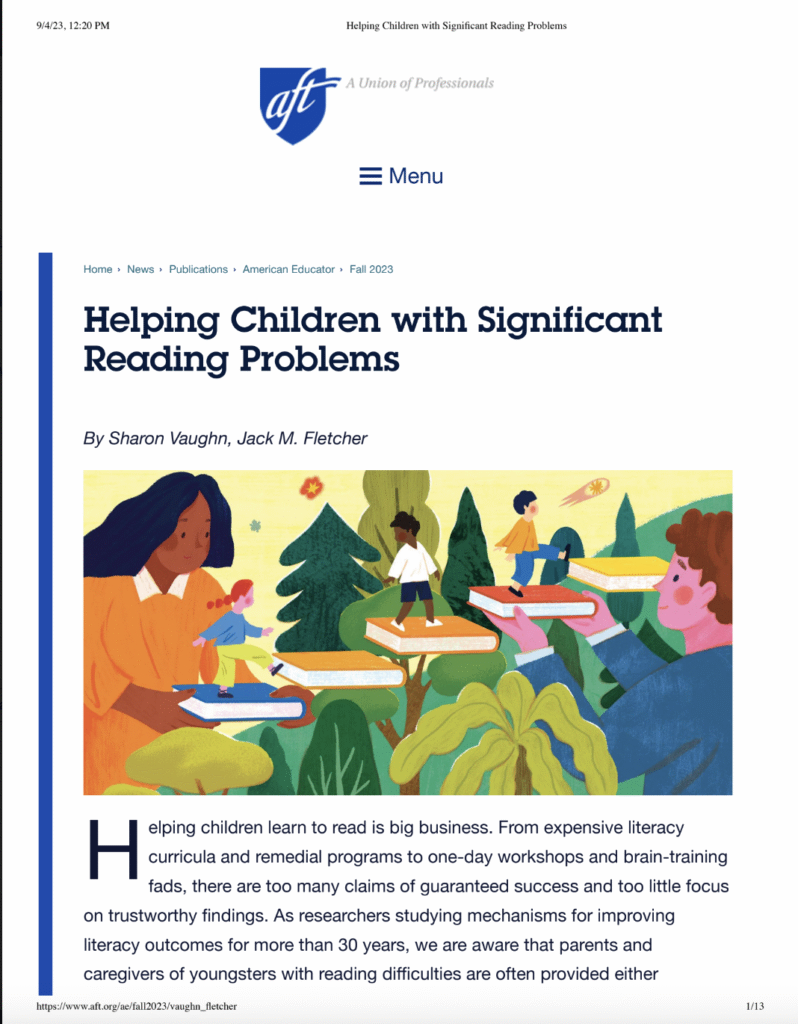
As you think about how to support your child’s reading development, the most important consideration is that they need as much time in reading and language arts instruction as possible.

 45
45 0
0

 1.12k
1.12k

 4501.12k